Chromium Blog
News and developments from the open source browser project
A QUIC update on Google’s experimental transport
Friday, April 17, 2015
Last year we announced QUIC
, a UDP-based transport protocol for the modern Internet. Over the last quarter, we’ve been increasing the amount of traffic to Google services that is served over QUIC and analyzing QUIC performance at scale. Results so far are positive, with the data showing that QUIC provides a real performance improvement over TCP thanks to QUIC's lower-latency connection establishment, improved congestion control, and better loss recovery.
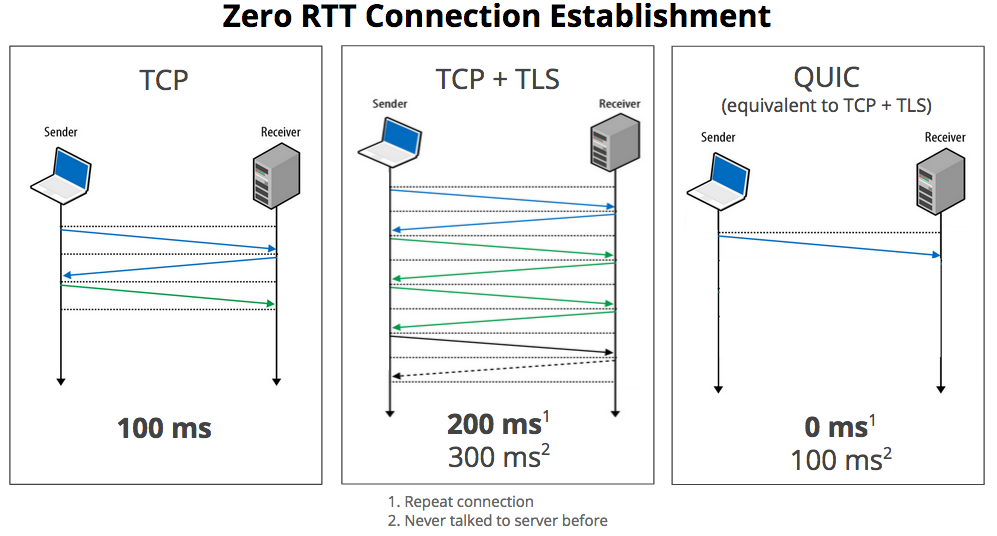
For latency-sensitive services like web search, the largest gains come from zero-round-trip connection establishment. The standard way to do secure web browsing involves communicating over TCP + TLS, which requires 2 to 3 round trips with a server to establish a secure connection before the browser can request the actual web page. QUIC is designed so that if a client has talked to a given server before, it can can start sending data without any round trips, which makes web pages load faster. The data shows that 75% percent of connections can take advantage of QUIC’s zero-round-trip feature. Even on a well-optimized site like Google Search, where connections are often pre-established, we still see a 3% improvement in mean page load time with QUIC.
Another substantial gain for QUIC is improved congestion control and loss recovery. Packet sequence numbers are never reused when retransmitting a packet. This avoids ambiguity about which packets have been received and avoids dreaded retransmission timeouts. As a result, QUIC outshines TCP under poor network conditions, shaving a full second off the Google Search page load time for the slowest 1% of connections. These benefits are even more apparent for video services like YouTube. Users report 30% fewer rebuffers when watching videos over QUIC. This means less time spent staring at the spinner and more time watching videos.
Where do we go from here? Today, roughly half of all requests from Chrome to Google servers are served over QUIC and we’re continuing to ramp up QUIC traffic, eventually making it the default transport from Google clients — both Chrome and mobile apps — to Google servers. We plan to formally propose QUIC to the IETF as an Internet standard but we have some housekeeping to do first, like changing the wire format and updating our reference implementation from SPDY-over-QUIC to HTTP2-over-QUIC. In the coming months, we also plan to work on lowering handshake overhead to allow better server-side scalability, improving forward error correction and congestion control, and adding support for multipath connections.
If you want to follow along or play around, feel free to check out the
code
and
experiment
with it, or join
proto-quic@chromium.org
as we continue to improve the Internet, one packet at a time.
Posted by SYN, SYN-ACK and ACK (also known as Alyssa Wilk, Ryan Hamilton and Ian Swett)
Labels
$200K
1
10th birthday
4
abusive ads
1
abusive notifications
2
accessibility
3
ad blockers
1
ad blocking
2
advanced capabilities
1
android
2
anti abuse
1
anti-deception
1
background periodic sync
1
badging
1
benchmarks
1
beta
83
better ads standards
1
billing
1
birthday
4
blink
2
browser
2
browser interoperability
1
bundles
1
capabilities
6
capable web
1
cds
1
cds18
2
cds2018
1
chrome
35
chrome 81
1
chrome 83
2
chrome 84
2
chrome ads
1
chrome apps
5
Chrome dev
1
chrome dev summit
1
chrome dev summit 2018
1
chrome dev summit 2019
1
chrome developer
1
Chrome Developer Center
1
chrome developer summit
1
chrome devtools
1
Chrome extension
1
chrome extensions
3
Chrome Frame
1
Chrome lite
1
Chrome on Android
2
chrome on ios
1
Chrome on Mac
1
Chrome OS
1
chrome privacy
4
chrome releases
1
chrome security
10
chrome web store
32
chromedevtools
1
chromeframe
3
chromeos
4
chromeos.dev
1
chromium
9
cloud print
1
coalition
1
coalition for better ads
1
contact picker
1
content indexing
1
cookies
1
core web vitals
2
csrf
1
css
1
cumulative layout shift
1
custom tabs
1
dart
8
dashboard
1
Data Saver
3
Data saver desktop extension
1
day 2
1
deceptive installation
1
declarative net request api
1
design
2
developer dashboard
1
Developer Program Policy
2
developer website
1
devtools
13
digital event
1
discoverability
1
DNS-over-HTTPS
4
DoH
4
emoji
1
emscriptem
1
enterprise
1
extensions
27
Fast badging
1
faster web
1
features
1
feedback
2
field data
1
first input delay
1
Follow
1
fonts
1
form controls
1
frameworks
1
fugu
2
fund
1
funding
1
gdd
1
google earth
1
google event
1
google io 2019
1
google web developer
1
googlechrome
12
harmful ads
1
html5
11
HTTP/3
1
HTTPS
4
iframes
1
images
1
incognito
1
insecure forms
1
intent to explain
1
ios
1
ios Chrome
1
issue tracker
3
jank
1
javascript
5
lab data
1
labelling
1
largest contentful paint
1
launch
1
lazy-loading
1
lighthouse
2
linux
2
Lite Mode
2
Lite pages
1
loading interventions
1
loading optimizations
1
lock icon
1
long-tail
1
mac
1
manifest v3
2
metrics
2
microsoft edge
1
mixed forms
1
mobile
2
na
1
native client
8
native file system
1
New Features
5
notifications
1
octane
1
open web
4
origin trials
2
pagespeed insights
1
pagespeedinsights
1
passwords
1
payment handler
1
payment request
1
payments
2
performance
20
performance tools
1
permission UI
1
permissions
1
play store
1
portals
3
prefetching
1
privacy
2
privacy sandbox
4
private prefetch proxy
1
profile guided optimization
1
progressive web apps
2
Project Strobe
1
protection
1
pwa
1
QUIC
1
quieter permissions
1
releases
3
removals
1
rlz
1
root program
1
safe browsing
2
Secure DNS
2
security
36
site isolation
1
slow loading
1
sms receiver
1
spam policy
1
spdy
2
spectre
1
speed
4
ssl
2
store listing
1
strobe
2
subscription pages
1
suspicious site reporter extension
1
TCP
1
the fast and the curious
28
TLS
1
tools
1
tracing
1
transparency
1
trusted web activities
1
twa
2
user agent string
1
user data policy
1
v8
6
video
2
wasm
1
web
1
web apps
1
web assembly
2
web developers
1
web intents
1
web packaging
1
web payments
1
web platform
1
web request api
1
web vitals
1
web.dev
1
web.dev live
1
webapi
1
webassembly
1
webaudio
3
webgl
7
webkit
5
WebM
1
webmaster
1
webp
5
webrtc
6
websockets
5
webtiming
1
writable-files
1
yerba beuna center for the arts
1
Archive
2026
Mar
2025
Oct
Jul
Jun
May
Jan
2024
Dec
Aug
Jun
May
Apr
Mar
Feb
2023
Nov
Oct
Sep
Aug
Jun
May
Apr
Feb
2022
Dec
Sep
Aug
Jun
May
Apr
Mar
Feb
Jan
2021
Dec
Nov
Oct
Sep
Aug
Jul
Jun
May
Apr
Mar
Feb
Jan
2020
Dec
Nov
Oct
Sep
Aug
Jul
Jun
May
Apr
Mar
Feb
Jan
2019
Dec
Nov
Oct
Sep
Aug
Jul
Jun
May
Apr
Mar
Feb
Jan
2018
Dec
Nov
Oct
Sep
Aug
Jul
Jun
May
Apr
Mar
Feb
Jan
2017
Dec
Nov
Oct
Sep
Aug
Jul
Jun
May
Apr
Mar
Feb
Jan
2016
Dec
Nov
Oct
Sep
Aug
Jun
May
Apr
Mar
Feb
Jan
2015
Dec
Nov
Oct
Sep
Aug
Jul
Jun
May
Apr
Mar
Feb
Jan
2014
Dec
Nov
Oct
Sep
Aug
Jul
Jun
May
Apr
Mar
Feb
Jan
2013
Dec
Nov
Oct
Sep
Aug
Jul
Jun
May
Apr
Mar
Feb
Jan
2012
Dec
Nov
Oct
Sep
Aug
Jul
Jun
May
Apr
Mar
Feb
Jan
2011
Dec
Nov
Oct
Sep
Aug
Jul
Jun
May
Apr
Mar
Feb
Jan
2010
Dec
Nov
Oct
Sep
Aug
Jul
Jun
May
Apr
Mar
Feb
Jan
2009
Dec
Nov
Sep
Aug
Jul
Jun
May
Apr
Mar
Feb
Jan
2008
Dec
Nov
Oct
Sep
Feed
Follow @ChromiumDev
Give us feedback in our
Product Forums
.